Tomato-fest

Our beautiful market stall

Tomatoes, tomatoes, tomatoes!  Do I sound redundant?  We are picking, sorting, eating and breathing tomatoes!  We see tomatoes in our sleep.  It’s been wicked busy here at the farm.  I’ve been going to market on Wednesdays and Fridays by myself, while Val stays at the farm picking more tomatoes.  Saturday we go together as it’s non stop at market…one selling, one stocking.  You would think we would have our fill by the end of the week, but not on your life.  Now it’s time to put up the larder!

We are roasting, dehydrating, canning sauce and chopped tomatoes, as well as making salsa, to be used during the late fall and winter months.  It is a total labor of love and one of the things that brought us together….our time in the kitchen.  Yet there is one thing that I make each summer that in my view is the reason for the season.  Just the thought of it will put a smile on my face and a song in my heart:  Uncooked Tomato Sauce!  I remember when I made it for the first time, about 25 years ago, how shocked I was by how just five simple ingredients could yield such an incredible flavor, but don’t be fooled! The paste tomatoes are just coming on, so I’ll make it as often as I can squeeze the time in to do it. And since I’m doing something that is a little labor intensive, I’ll make enough to change some into bruchetta.  On the days when the sweat is pouring off my face, I remember this is my reward!

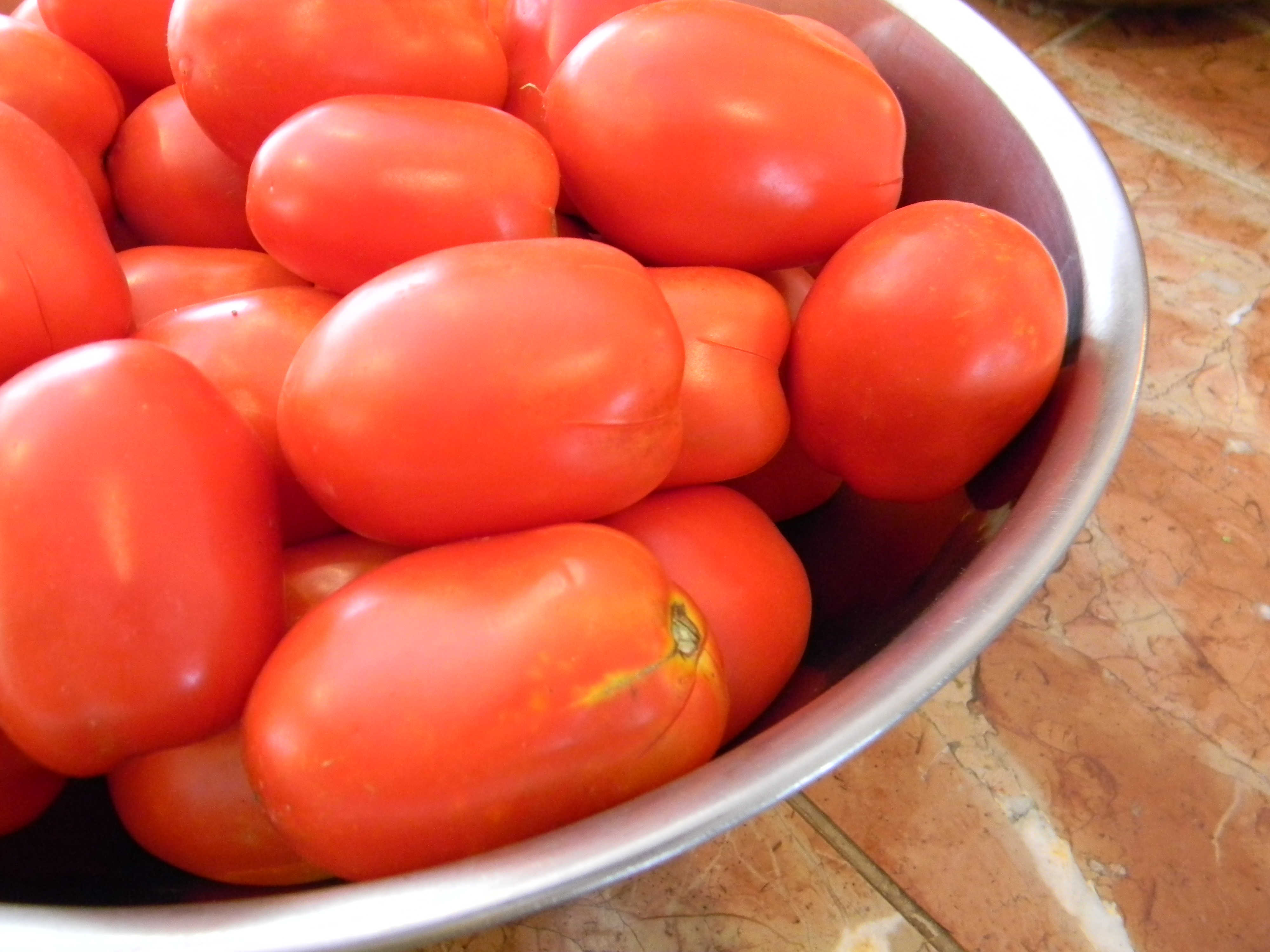
My beauties!

Uncooked Tomato Sauce:

  • 18 heirloom plum (paste) tomatoes, peeled, seeded and chopped
  • 1/2 to 1 cup good quality olive oil
  • 6 cloves fresh garlic, minced
  • 1/4 cup fresh basil, chopped
  • 1 tsp Kosher salt
  • 8 0z pasta of your choice

Patience is a virtue...waiting for the sauce to meld

  1. Put all ingredients except pasta in a glass or pottery bowl.  Let stand a minimum of 4-6 hours for the sauce to meld.  This allow for the salt to break down the tomatoes slightly and bleed into the olive oil.
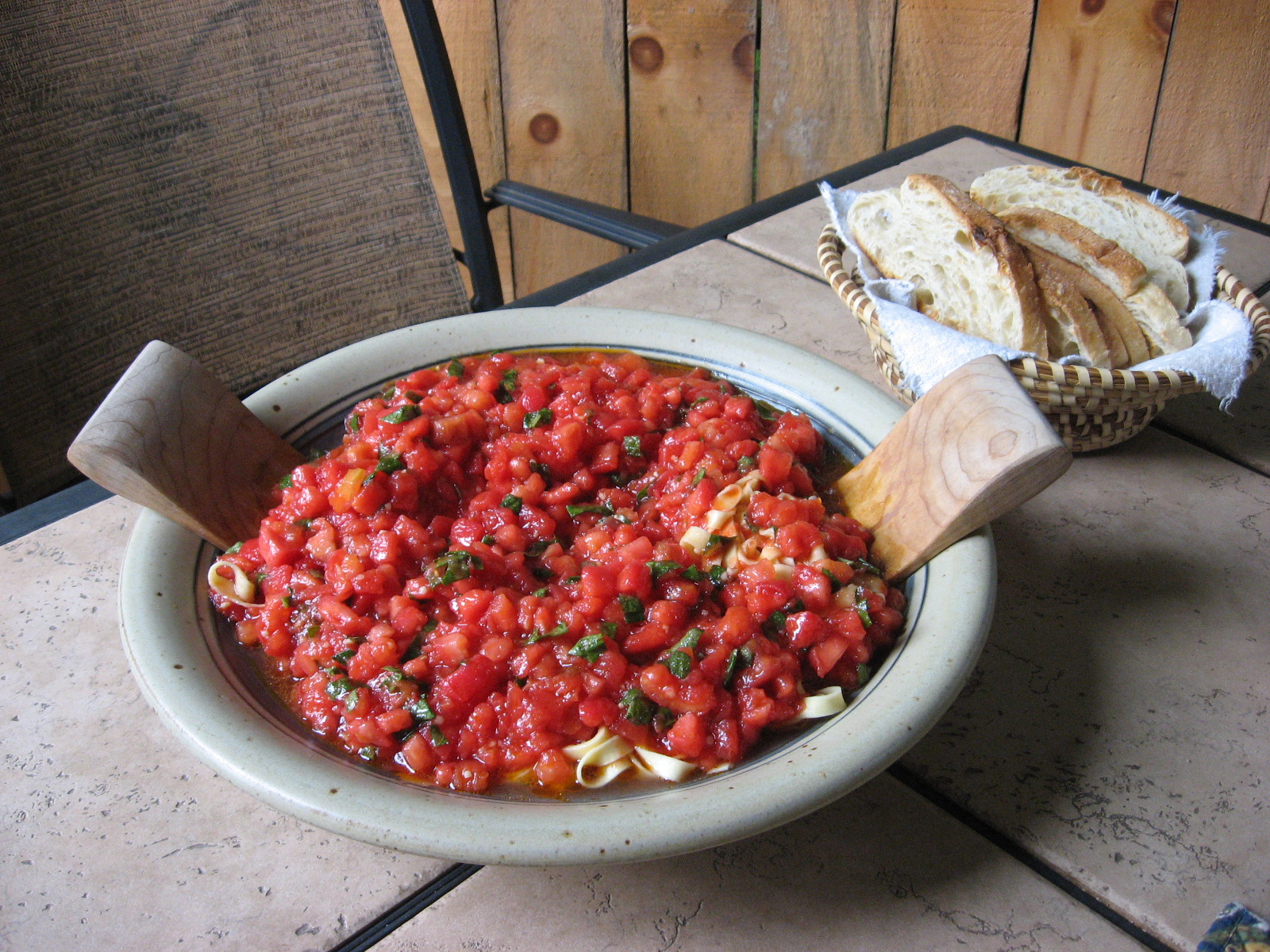
  2. Boil pasta according to package directions, drain.  Place in pasta bowl and pour sauce over warm pasta.  Serve immediately with lots of crusty Italian bread to sop up every bit of summer!

OMG!!

Brickyard Farms Crostini:

To one recipe of fresh tomato sauce add the following:

  • 1 Tbsp balsamic vinegar
  • 3 Tbsp red onion, finely chopped
  • 2 Tbsp capers, drained
  • 3 Tbsp kalamata olives, pitted and coarsely chopped
Spread on grilled or toasted French or Italian bread.  Allow the juice to soak in.

The next best thing to uncooked tomato sauce

Good food is good for the soul!


Posted in Farm News, Raves, Recipes | Tagged , , , , , , | 5 Comments

A Glut of Cherry Tomatoes!

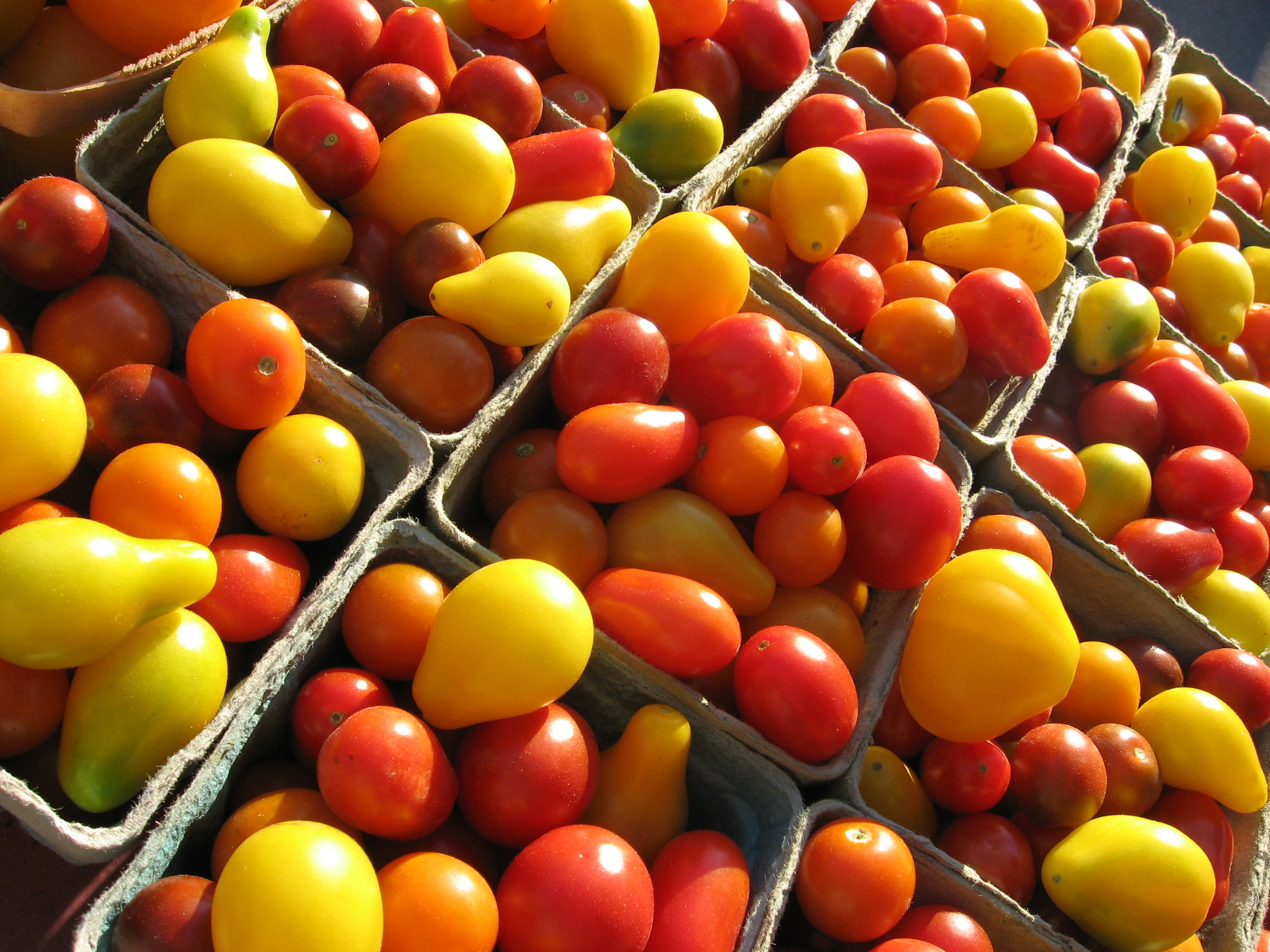
Cherry Tomatoes Galore!

August is the month of abundance at the farmers market.  We were running late and customers were coming early.  We never really got set up completely.  Forget signs and our soap products.  Everyone was wanting tomatoes, beans, onions, carrots and beets.  We were selling produce as fast as we could put it on the stand.  Val and I were bagging, filling, talking and selling at record speed.  This all came to a screeching halt when the sky opened up around noon and the monsoon started.  Customers were running to their cars and only the intrepid kept shopping.  Val and I looked at each other and burst out laughing.  No rain was predicted today and here we were in a heavy down pour.  The last hour and a half of market was understandably quiet.

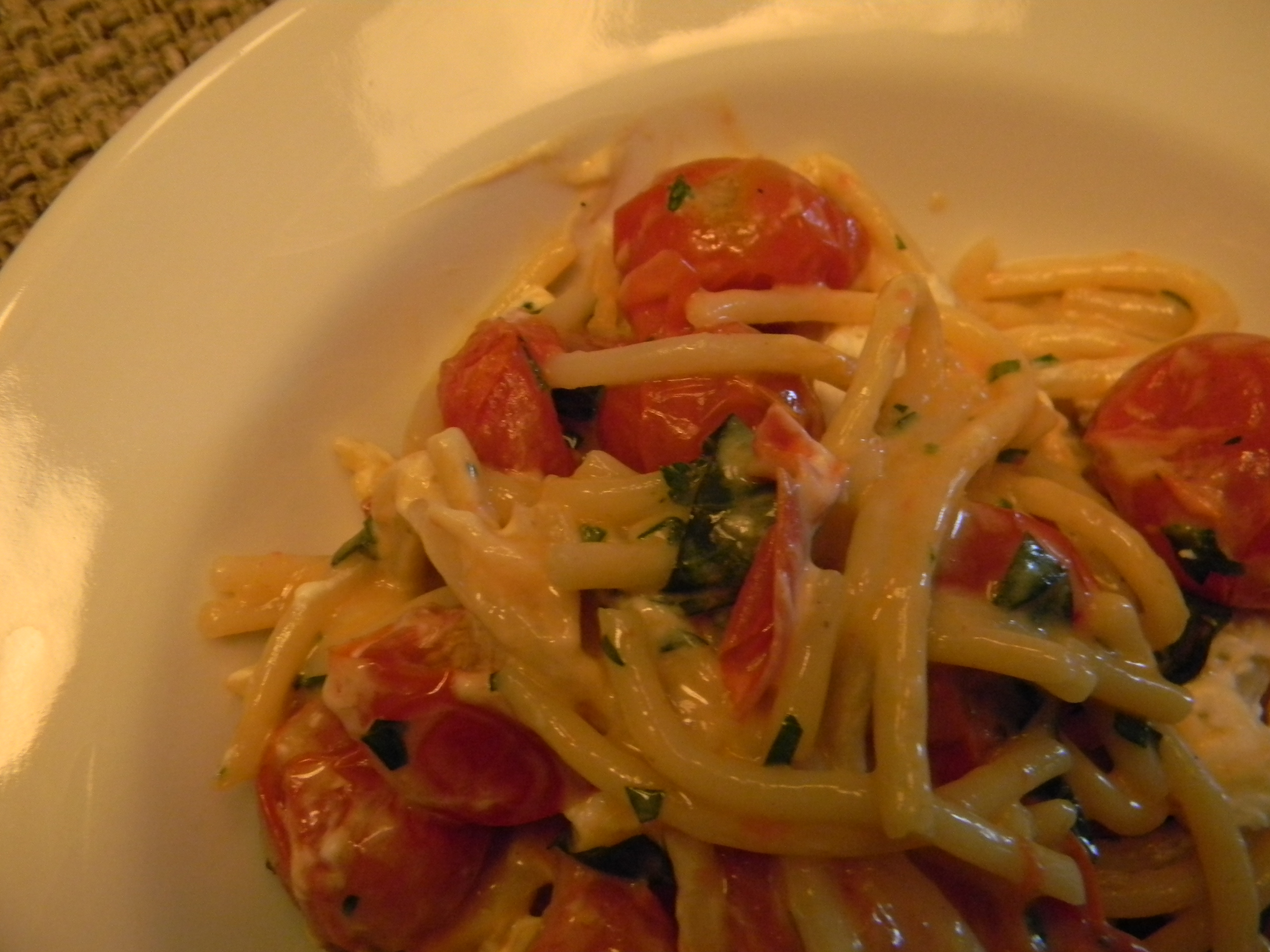
So here we were packing up with a glut of cherry tomatoes and no customers.  We dismantled our stall and by the time we folded up our tarp we were soaked to the skin.  Unpredictable weather keeps following us around like a bad penny.  Undeterred, we drove home chatting about what to do with all the cherries.  We decided to freeze most of them, then vacuum seal them for winter.  That way we could make pasta sauces, roast them as a side dish or add them to other recipes.  I filled gallon zip lock bags with cherries and stacked them on a jelly-roll pan to place in the freezer.  Once frozen I would bag them in 4 cup pouches for later use.  I saved two pints to make a pasta sauce of roasted cherry tomatoes, fresh basil, parsley and goat cheese.  It rained for much of the day on Sunday which allowed us to pickle beets, dehydrate apricots, freeze cherries and enjoy a nice dinner together.  We ended up thanking the rain gods after all.

Roasted Cherry Tomatoes with Chevre:

  • 12 oz pasta of your choice (we like bucatini which is slightly larger than regular spaghetti)
  • 2 pints cherry tomatoes, use a variety for color
  • 3 Tbsp extra-virgin olive oil, divided
  • 1 Tbsp red wine vinegar
  • 1/2 tsp Kosher salt
  • 1/4 tsp crushed red pepper flakes
  • 1/4 cup fresh basil, cut in ribbons
  • 1/4 cup fresh Italian parsley, chopped coarsely
  • 3/4 cup (3 oz) crumbled fresh chevre (semi-soft goat cheese)
  1. Preheat oven to 450 degrees.
  2. Bring 4 quarts of water to a boil in a large Dutch oven.  Add 1 Tbsp salt to water and add pasta;  cook according to package directions.  Drain pasta in a colander over a bowl, reserving 1/2 cup cooking water.  Return pasta to pan to keep warm.
  3. While pasta cooks, combine tomatoes, vinegar, olive oil, 1/2 tsp salt and red pepper flakes on a jelly-roll pan, tossing well to coat.  Roast for 10-20 minutes or until tomatoes are soft and slightly charred in places.
  4. Add tomatoes and any juices to pasta in Dutch oven.  Add 1/4 cup of the reserved cooking water to jelly-roll pan to loosen up browned bits.  Add this to the pasta, along with additional 2 Tbsp olive oil.
  5. Add 1/2 of chevre to pasta, along with basil, parsley and remaining cooking water.  Toss thoroughly.
  6. Place in serving bowl and sprinkle with remaining chevre.
Yield:  4-6 servings

From glut to goodness

“Tell me what you eat, and I will tell you who you are.”  –Jean Anthelme

Posted in Farm News, Recipes, Vegetables | Tagged , , , , , | 2 Comments

Filling Our Larder: Frugal Meets Flavor

There was a time when nothing was wasted.  Everything had a viable use or was shared with others less fortunate.  In this land of abundance, many of us are learning to tighten our belts a little more, as the economy flounders and the future seems uncertain.  This includes our food budgets.

Our market neighbor, whose family owns a third-generation orchard was lamenting that it was hard for him to return home with his ‘seconds’ and throw them in the woods for the deer and other animals to eat.  It used to be that these seconds would be made into preserves or jams and distributed to the families that worked the farm or stored in the family’s larder for winter use.  When Val mentioned to him that we could find a use for the fruit he couldn’t sell, he was happy to offer them to us.  We knew it would not be wasted, as we had neighbors that also like to ‘put up’ food as a way of trimming their food budgets.  So we returned home that day with a half bushel of apricots and one of peaches.

We discussed on the way home what to do with our bounty.  We could dehydrate some of the fruit, or maybe make jams or preserves.  We decided on apricot-peach fruit butter.  After researching several different approaches, we liked the idea of reducing the pureed fruit in our crock-pot.  The thermometer was hovering in the 90’s, and the idea of heating up the kitchen any more than we had to came into the equation.  Our neighbors would not be returning from their family vacation until late Sunday and we knew the fruit would not wait in its current condition.  We decided to refrigerate it over-night, then dive into our project first thing the next morning.

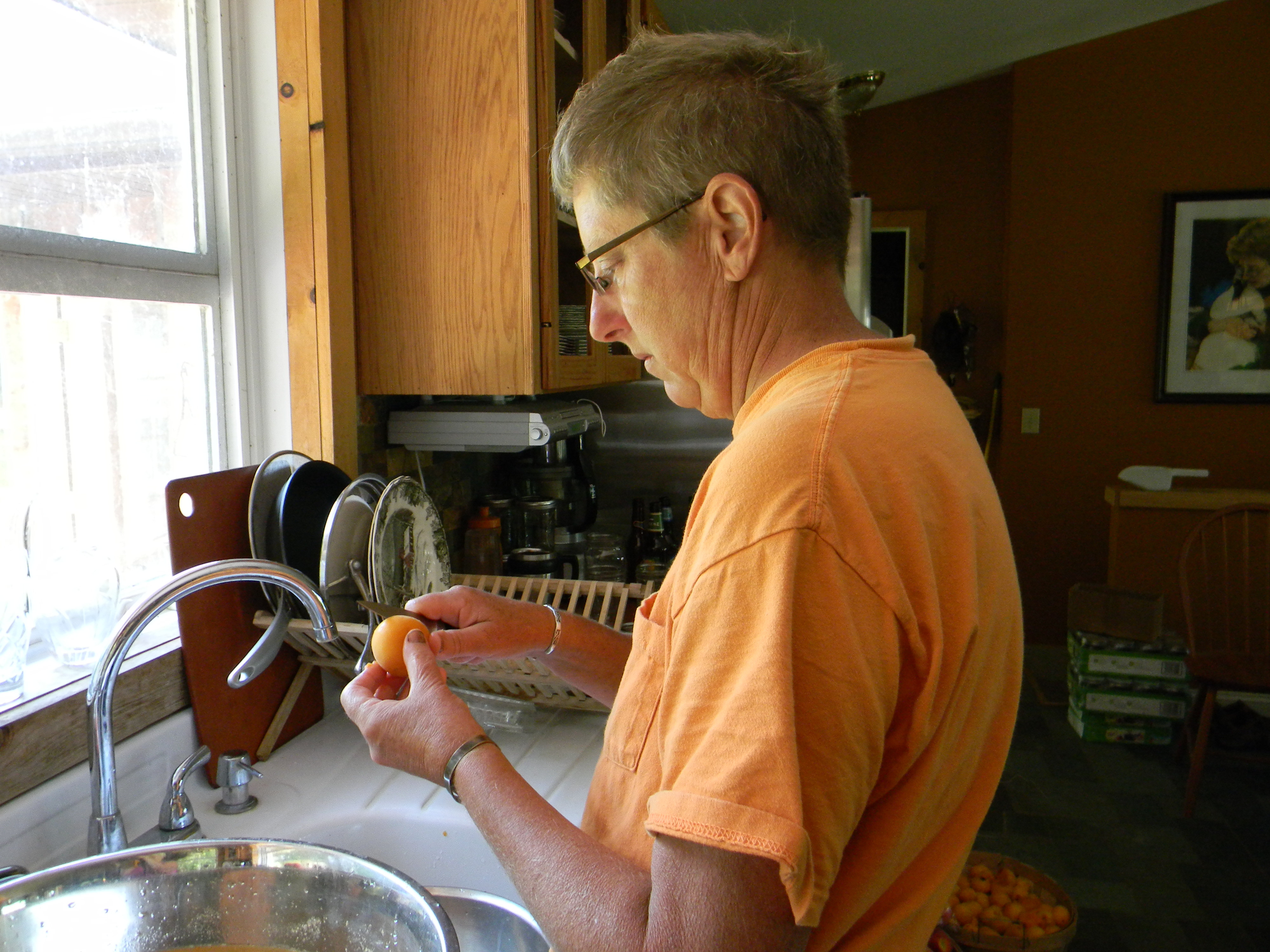
Over Sunday morning coffee, we decided we would make a double batch of fruit butter, puree the remaining fruit and freeze it in zip-lock bags for a cooler time when we had the inclination to make jam or additional fruit butter as holiday gifts.  This would buy us some time, not waste any of the precious fruit and allow us flexibility in creating uses for the rest of it.  Rather than blanching the fruit to remove the skin, we decided to use our Vita-Mix for the apricots, which would puree it in no time.  We would peel the peaches so we could identify bad spots, and remove the fuzz.  I also preferred honey to refined sugar, although this would mean keeping a close eye on the slow-cooker and stirring more frequently (small sacrifice).

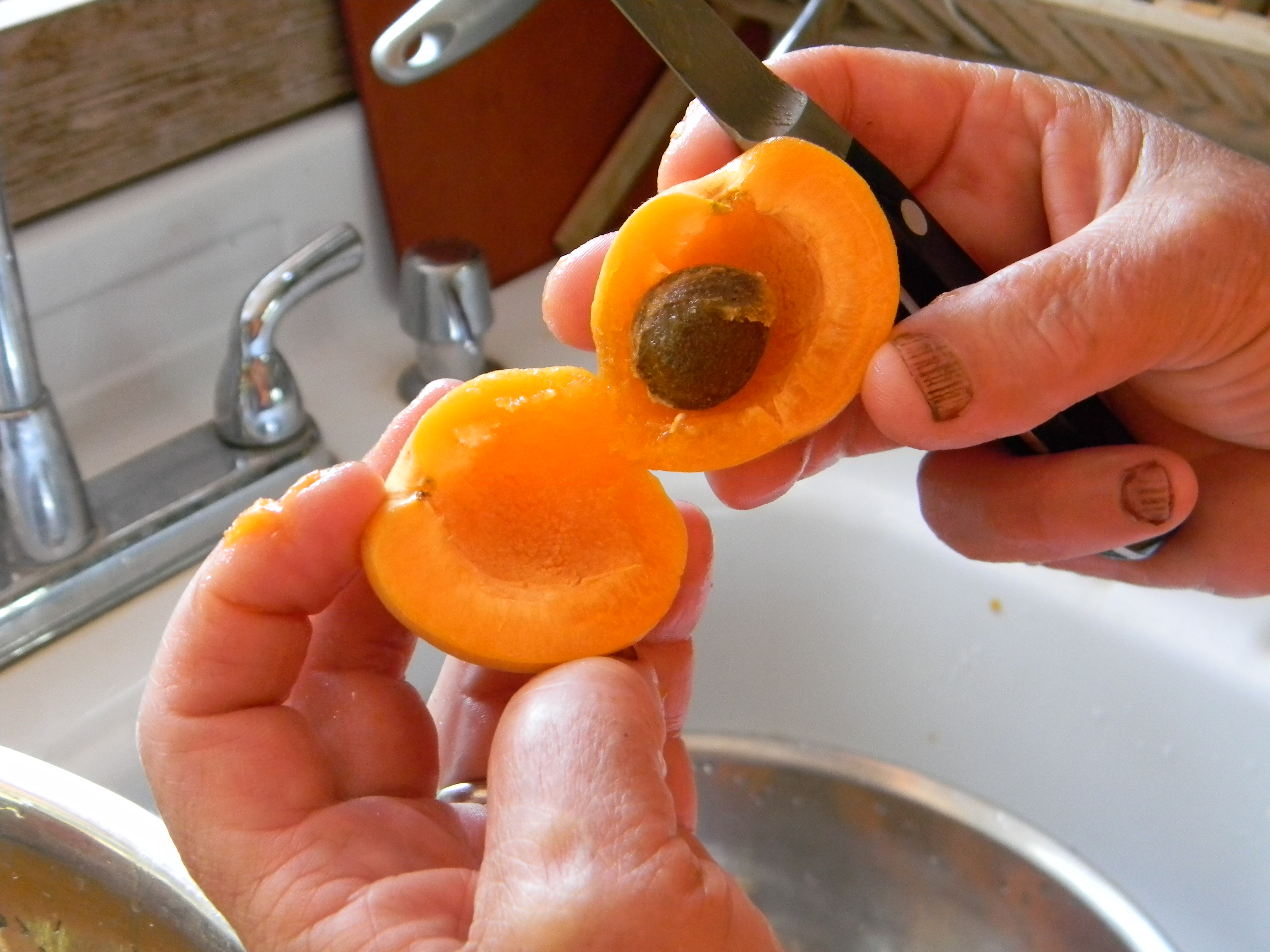
Val prepares apricots

These beauties don't look like 'seconds'

Apricots in Vita Mix

Extra apricot puree ready for freezer

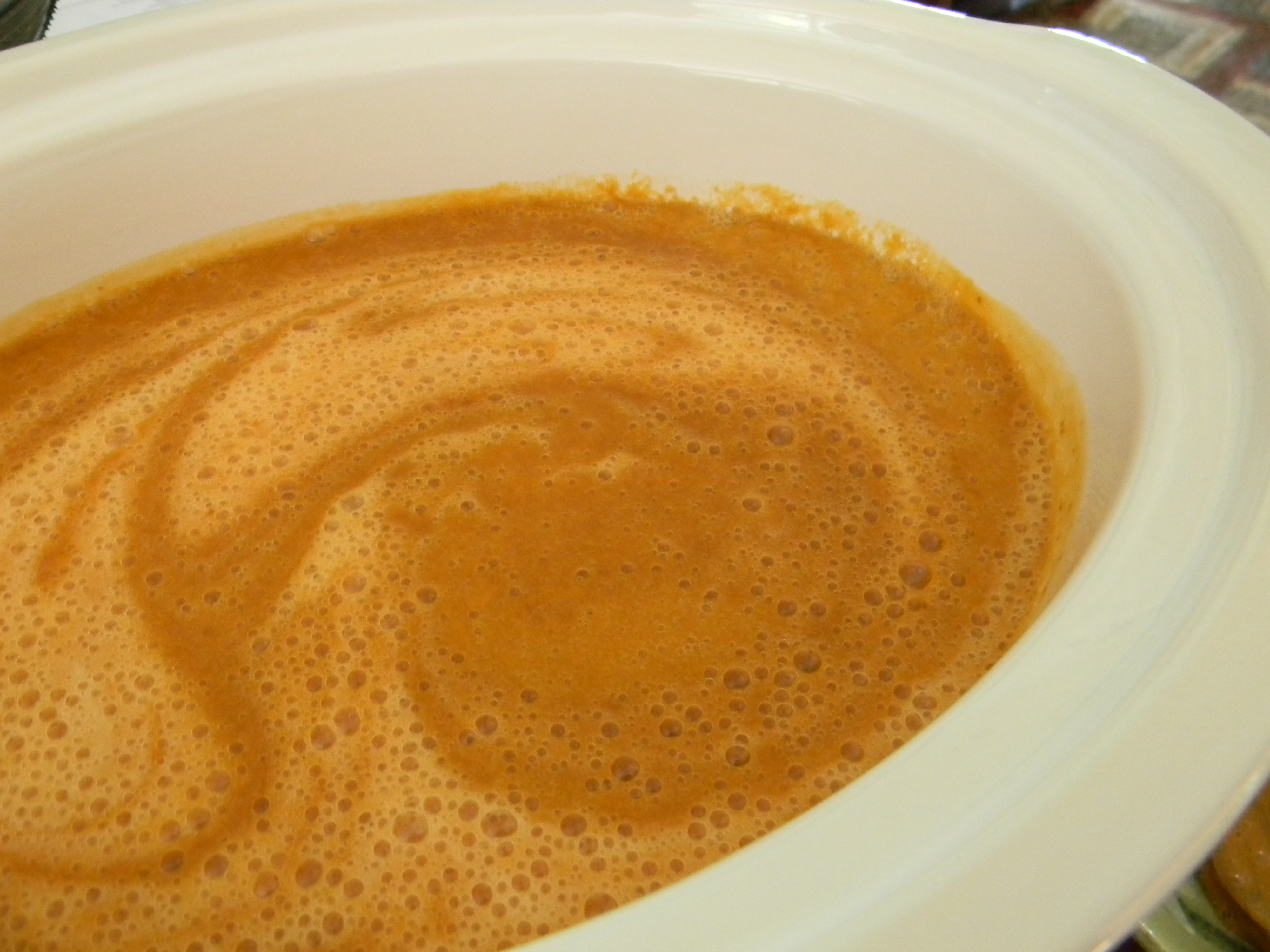
Slow cooking fruit butter

Apricot-Peach Butter

  • 5 cups pureed apricots, halved and pitted
  • 4 cups pureed peaches, peeled and pitted
  • juice of one lemon (or less depending on your taste)
  • 1/2 tsp of cinnamon, optional
  • 1 vanilla bean
  • 1/4 to 1/3 cup fresh local honey
  1. Put pureed fruit in crock-pot with vanilla bean.  Cook on low setting for 8-10 hours or until the fruit has reduced by about half and is thick but still moist.
  2. After 4 hours, add 1/4 to 1/3 cup honey depending on your taste.  I prefer it a little less sweet.  Stir often to prevent scorching.
  3. When fruit butter is thick and reduced by half, turn off and add cinnamon.
  4. Place in sterilized 8 0z jam jars and process in water bath for 20 minutes, leaving 1/2 inch head space.
This will yield about 5 cups of butter or 5 jelly jars.  You can also freeze the butter if you choose not to can it.  I prefer to can it for gift giving.

Finished Apricot-Peach Butter

“You don’t have to cook fancy or complicated masterpieces, just good food with fresh ingredients.”  –Julia Child

Posted in Farm News, Raves, Recipes | Tagged , , , , , , , , , , , | 2 Comments

Hubs of Hell

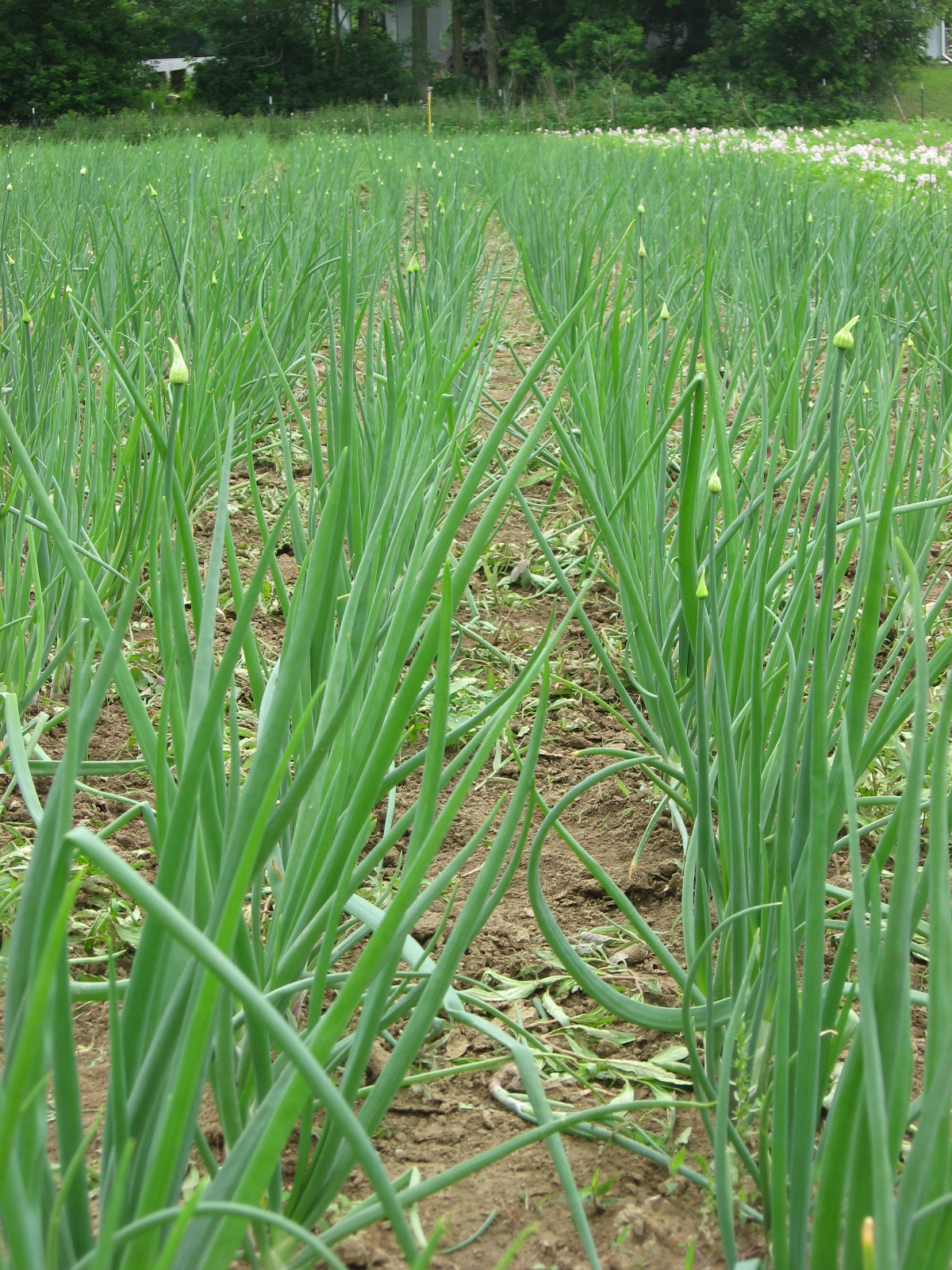
Onions love the hot humid weather

When the phone rang the other day, Val cheerfully answered, “Hello, hubs of hell!”  She wasn’t kidding either.  With the heat index peaking at 110 degrees, one has to wonder how in the world do you cope with the heat?  We usually put in six hours of labor a day.  At this time of year the pressure of keeping up with irrigating, weeding and harvesting is immense.  We take frequent breaks to drink tons of water and iced tea.  We sometimes surprise ourselves that we are able to make it through the day, knowing we can collapse in the air-conditioned house when we are done.

Farmers and weather have always had a sort of love/hate relationship.  As I do research for my next book, Full:  Learning to Feed Ourselves, weather and climate change become more important to each of us as our adaptability to these conditions will become crucial.  The statistics concerning our most recent heat event was well documented by NOAA.  Nationally, 1,966 daily high maximum temperature records were broken or tied so far this month.  Sixty-six of those records were all-time maximum temperature records.  But it wasn’t only the record-breaking high temperatures that were a concern, it was also the record-breaking minimum temperatures that surprised experts as well.  Because of the extremely high humidity levels during this heat wave, 4,376 record highest minimum temperature records were broken or tied through July 23.  Of those minimum temperature records, 158 were all-time records.  Warm nighttime temperatures remained above 80 degrees in many areas.

Should we be concerned?  Only if we want to continue to eat.  Corn for example will not survive 135 degree temperatures; nor will farmers along the Mississippi be able to continue to grow organically if their ground has been polluted by flooding.  As more and more corporate crops are severely challenged or fail completely, food prices will continue to soar.  Each region of the country will be learning what it will take to survive in a climate challenged world.  This will directly impact local farmers, communities and anyone interested in adopting and finding local solutions for planning for the future.

With all these dire predictions, is it any wonder we can get out of bed in the morning?  The true meaning of optimist is remembering that nothing is ever quite as bad as it could be.  Farmers have long known that they do not control the weather, but have indeed learned skills of adaptability.  The smaller the farm, the more personal it becomes.  Nature at once beautiful and harsh has lessons for humanity.  If the new normal is extreme weather, lets learn how to adapt by growing crops that can survive these changes and feed us locally.

“To cherish what remains of the Earth and to foster its renewal is our only legitimate hope of survival.”  –Wendell Berry

Posted in Essays, Farm News, Food Issues, Rants | Tagged , , , , , , | Leave a comment

Helping Hands

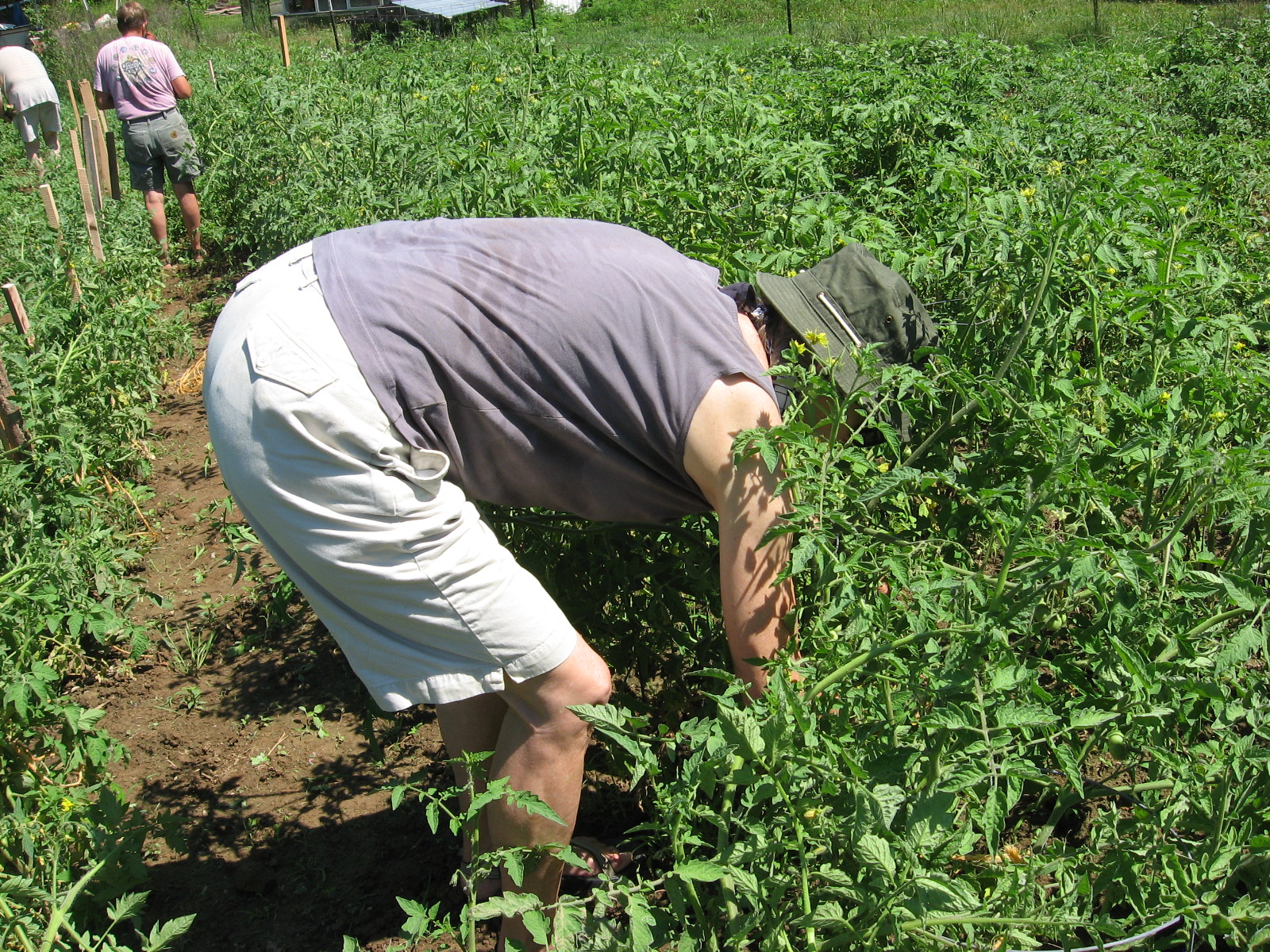
Robin tying up plants

Last week, after a storm that brought us severe winds, we were faced with staking up 800 of our 1800 tomato plants in 90 degree temperatures.  Although we are used to hard work on the farm, we were thrilled when Val’s sister Jude, her partner Robin and our brother-in-law Gary came to the rescue with additional helping hands.  Boy were they troopers! All of them being retirees, none of them were used to physical labor of this kind. Jude and Robin were visiting from San Francisco for the week and gave up relaxation time, came out to the farm, to sweat and get dirty.

Rest break

Our family is always amazed at the amount of produce that comes off our 5.5 acre farm.  We have a basic schedule of weeding in the mornings and harvesting in the afternoons.  But when the unexpected happens like storms or pest infestations, we deal with things in the moment of the temporary crisis.  This of course can put us behind for the week, but with the help from our amazing family, the tomatoes were staked and tied in 6 grueling hours (and they still love us!).  After drinking gallons of ice water, breaks for the heat index and sore muscles, we felt we needed to refresh them with showers, drinks and a decent meal.

They had seen the Tuscan Kale Caesar Salad on last week’s post and wanted to try it, so I picked some fresh kale, while Jude and Val dug up fingerling potatoes. We decided to grill filet mignon, then Robin suggested we grill the fingerlings too.  I realized that for all the cooking I have done, I have never roasted potatoes that way.  Don’t ask me why; I don’t have an answer.  So I proceeded to toss them in olive oil, sea salt and minced fresh rosemary.  I couldn’t resist adding some of our hard-neck garlic as well.

Freshly dug fingerlings ready for the grill

We have a gas grill, so I heated it to 400 degrees, put the fingerlings right on the grate and tossed them occasionally.  They were done to perfection in 20 minutes.  Where have I been?  I had missed something this good?

Fresh, grilled and delicious!

I made everyone Brickyard Farms Coolers, and we were ready for a great meal from the farm.  I never take for granted how fortunate we are to walk into our fields to harvest food for dinner.  It just doesn’t get better than this!

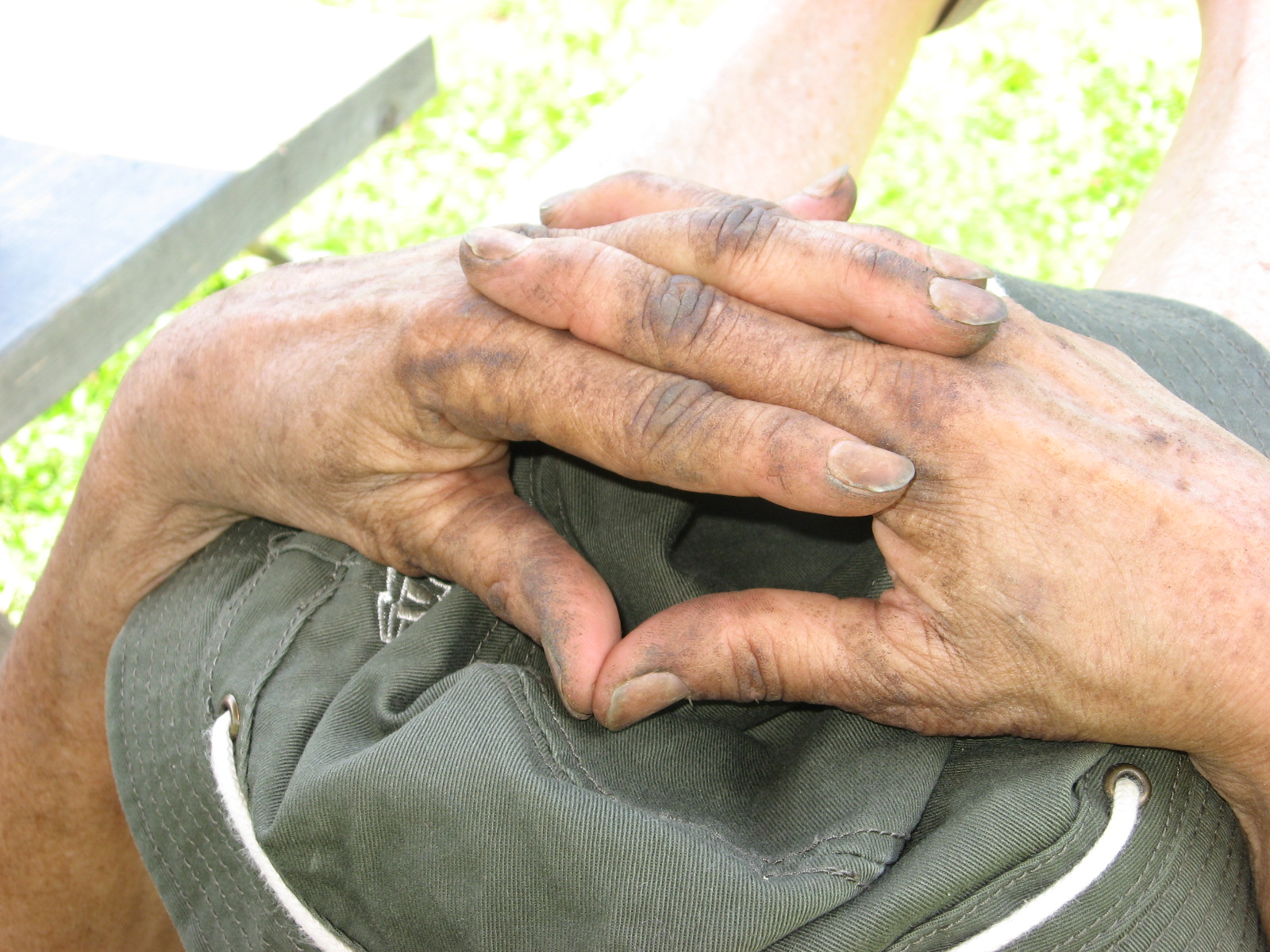
Val, me, Jude and Robin showing off their earthy hands!

Gratitude is the memory of the heart!  Thanks so much for all your help: Jude, Robin and Gary!

Posted in Essays, Farm News, Recipes, Vegetables | Tagged , , , , , , , | 4 Comments

Simple Abundance

What a week!  Temperatures in the 90’s, endless weeds to pull and more produce than you can imagine.  We went to market Saturday with carrots, beets, new potatoes, peas, Swiss chard, onions and kale.  The onions, carrots and new potatoes literally flew off the stand!  I kept busy filling quarts of potatoes, with sweat dripping off my nose, elbows and chin until we sold out!  Our market stand was at one of its most colorful times of the year and I rushed off without my camera.  But just picture in your mind’s eye the beautiful red of the onions, the seven color carrots, maroon and golden beets, bright lights Swiss chard and the deep green of Tuscan kale.  A cornucopia of early summer vegetables.

We are relishing the abundance of the farm each day.  The new potatoes need only the simplest of adornments, like sweet butter and fresh dill.  Their earthiness shining through with each bite.  I put our fresh onions in everything from salads to salsas.  We will be pickling carrots and beets soon for our winter pantry as soon as we can find the time.  But for now we are enjoying Val’s sister Jude and her partner Robin who are visiting from San Francisco.  It’s been over a year since we have seen them, to share stories and laughter.

Today we had a full table:  my brother-in-law Gary, Jude and Robin, our dear neighbors and good friends Lynne, Stephanie and Tim.  I marinated flank steak for the grill, and we enjoyed three great salads.  Stephanie who is a wonderful cook always brings something interesting.  I love how she comes up with unusual combinations of color and textures.  Today she brought a salad of navy beans, Swiss chard, golden beets, green tomatoes, chives, garlic and dill.  I made a Caesar salad that makes good use of fresh young Tuscan kale.  I may never eat a traditional Caesar again!  A version of this recipe was in Bon Appetit, however their measurements were completely off for our tastes.  Also note that this makes enough dressing for 2 or 3 salads.  If you love it as much as we do, the dressing will keep for a week.  Here’s how we make it:

Tuscan Kale Caesar Salad:

Gorgeous fresh tuscan kale

  • 1/4 cup fresh lemon juice
  • 8 anchovy fillets, packed in oil, drained on paper towels
  • 4 garlic cloves
  • 2 tsp Dijon mustard
  • 3/4 cup extra-virgin olive oil
  • 3/4 cup finely grated Pecorino cheese, divided
  • Kosher salt & pepper to taste
  • 1 hard-boiled egg, peeled
  • 14 oz Tuscan kale (curly or Lacinato also work) center stalks removed, thinly sliced crosswise; about 8 cups
  1. Combine the first four ingredients in a blender or food processor; puree until smooth.  With machine running, slowly add oil, drop by drop, to make a creamy dressing.  Transfer to a bowl and stir in 1/4 cup of Pecorino.  Season with salt and pepper.  Keep chilled.
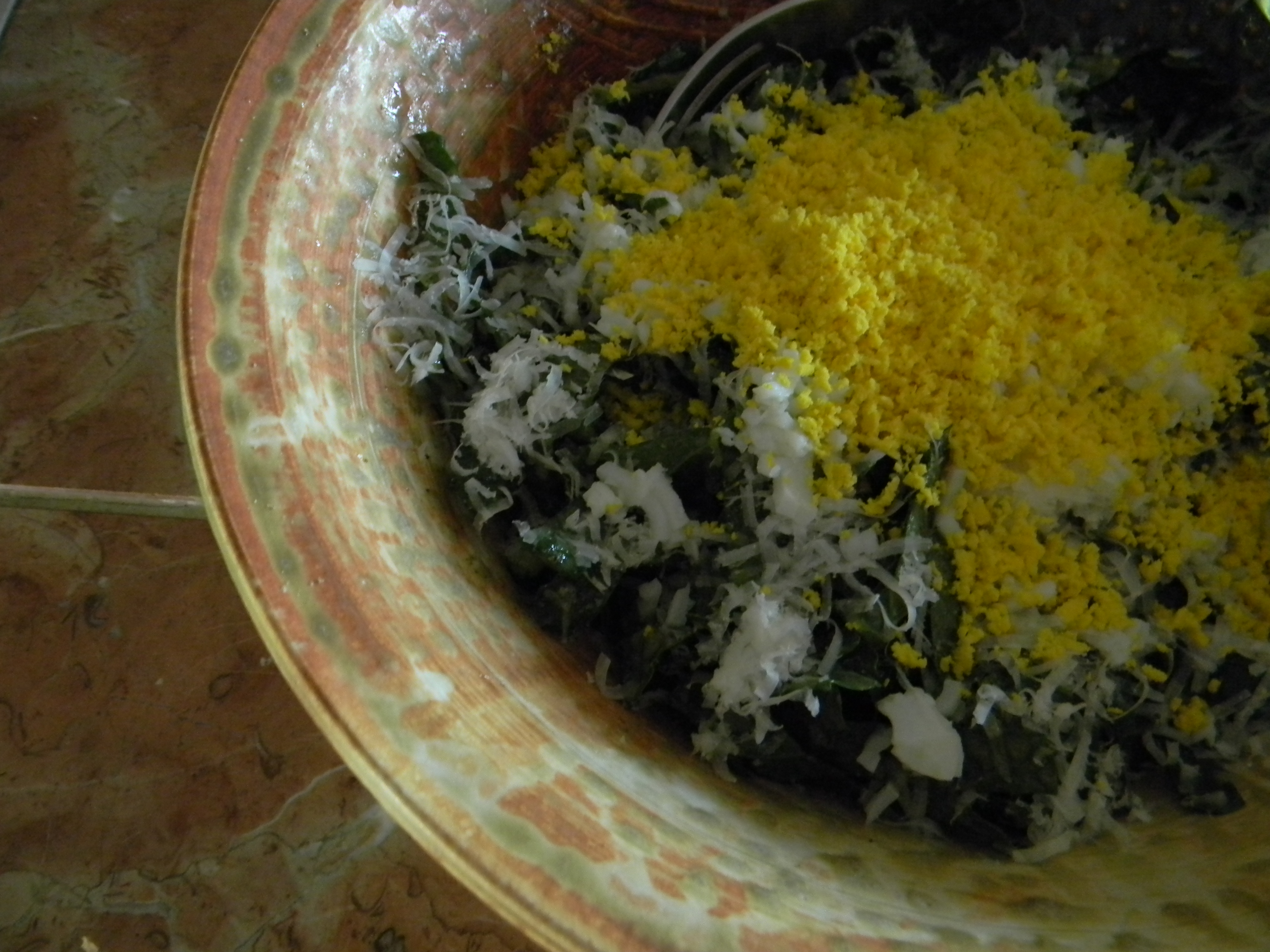
  2. Separate egg white from yolk.  Place egg white in a coarse-mesh strainer set over a bowl.  Press egg white through strainer with your fingers or back of a spoon; scrape egg white from bottom of strainer.  Repeat with egg yolk, using a clean strainer and bowl.  Can be made 6 hours ahead; cover and chill.
  3. Toss kale and dressing in bowl with hands.  Do not over dress (you don’t want to drown the kale, just dress it).  Keep extra dressing in refrigerator for next time.
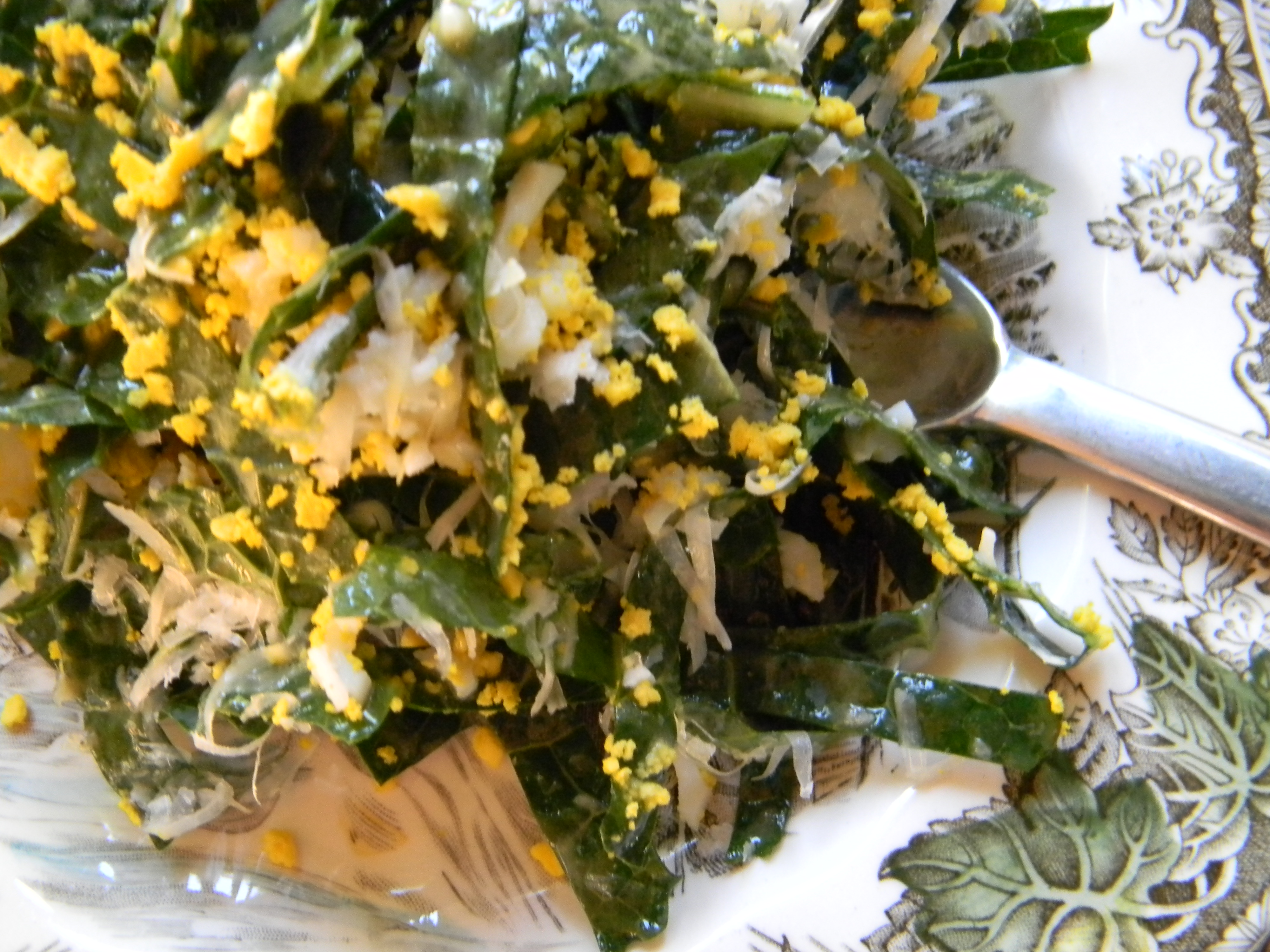
  4. Top with remaining 1/2 cup Pecorino, then egg white, finish with yolk.

A most attractive salad!

Yum!

One of the very nicest things about lifeis the way we must regularly stop whatever it is we are doing and devote our attention to eating. ~Luciano Pavarotti and William Wright, Pavarotti

Posted in Uncategorized | Tagged , , , , , , | 2 Comments

The Dirt on Weeding

There have been many changes since coming to the farm over four years ago.  One change that I thought I had made was adapting to physical labor.  Hadn’t I planted, weeded and harvested each season?  Didn’t I have the sore muscles to prove it?  Yet I know that when it comes to labor on the farm I was not doing my fair share.  Was it because my 57-year-old body was rebelling?

When I took the time to think this through, it occurred to me that deep down I did not really respect physical labor.  Perhaps I felt that growing food and working the land was for people who didn’t have other opportunities or education.  If you’re going to farm then at the very least make sure you do it in a big way so that you glean the respect of others.  How much respect could you get from a 5.5 acre truck farm?  I felt that what I could offer the farm was an expertise of some kind.  I have management and organizational skills and have applied these to the farm.  I have bookkeeping and computer skills and have used these on the farm.  I’m creative and enjoy coming up with new ideas.  I even wrote a book about my experiences on the farm.  What I really didn’t enjoy doing was:  weeding.

Yet how was our beautiful no-spray produce going to grow and mature without this basic task being done each day, every day, over and over and over until it was time to harvest the crop?  And why wouldn’t I naturally want to do what was necessary to care for what we grow, what we love?  Then the epiphany.  I have never given myself completely to what I love.

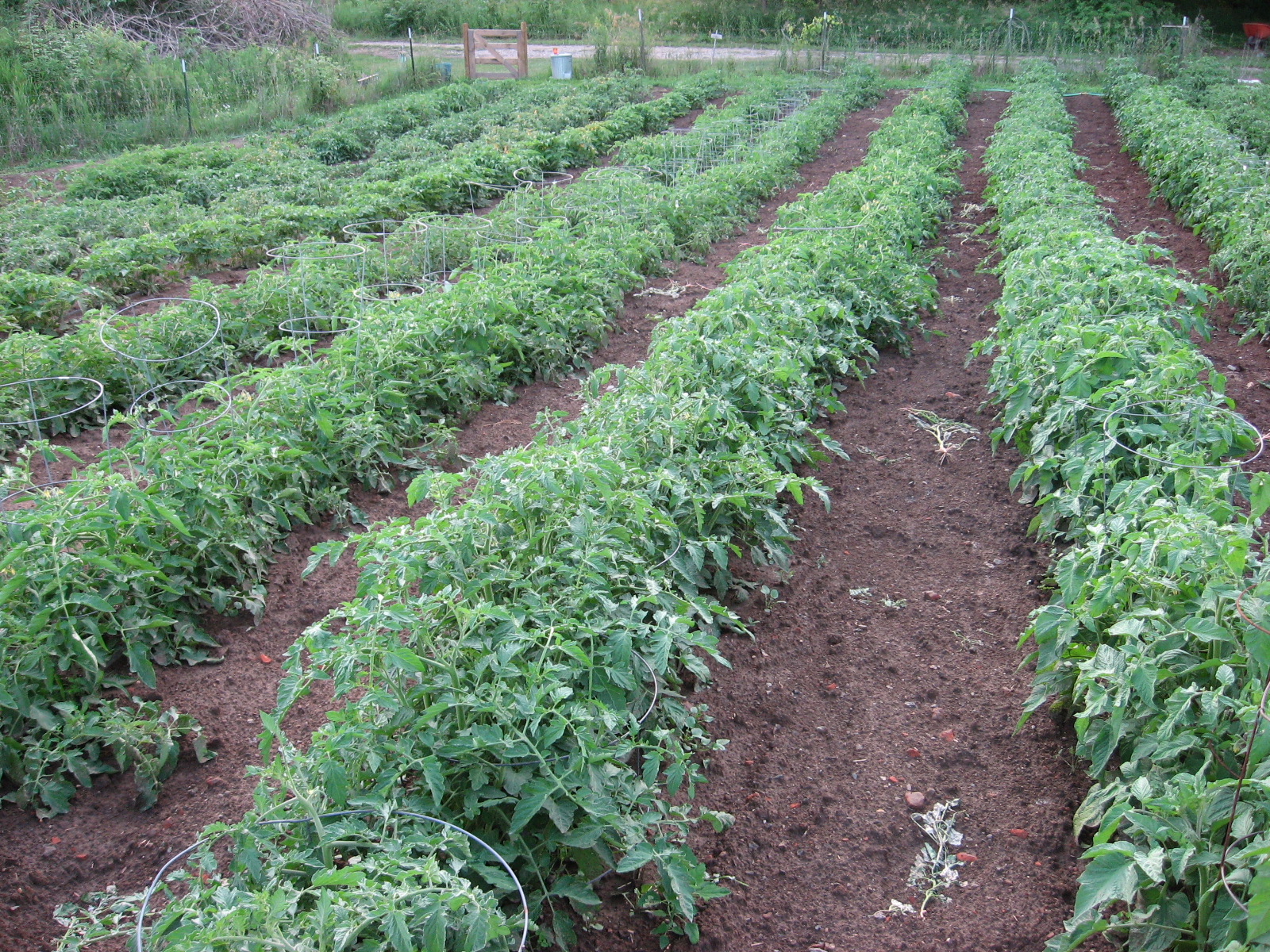
Beautiful weeded rows of tomatoes

So Val in her infinite wisdom asked that I keep the tomato field weed free, and I love tomatoes.  I gulped.  1400 tomato plants stood waiting for me.  I took on the challenge!  I broke it into rows that would keep it manageable and keep me from freaking out.  I knew that within a week I could get the job done.  Each day I would finish weeding and felt every single muscle of my arms and back.  I started feeling stronger both mentally and physically.  There was movement in my body, movement in my thinking, movement in my psyche.  I was in flux; I was changing.  I felt myself caring, really caring that I was weeding this field.  The tomato plants looked healthy; with blossoms on some, fruit setting on others.  I took a deep interest not only in the tomatoes, but all our crops;  how they were doing, what they might need.  I loved them.

This morning Val and I are sipping coffee outside, sitting on our Adirondack chairs, listening to the sprinklers.  I told her that I wanted to start eating as much from our farm as possible.  I felt renewed and wanted to recommit my energies to our farm’s success.  We toasted mugs and walked in the fields to pick Swiss chard for breakfast.

“Sweat cleanses from the inside.  It comes from places a shower will never reach.”            —George Sheehan

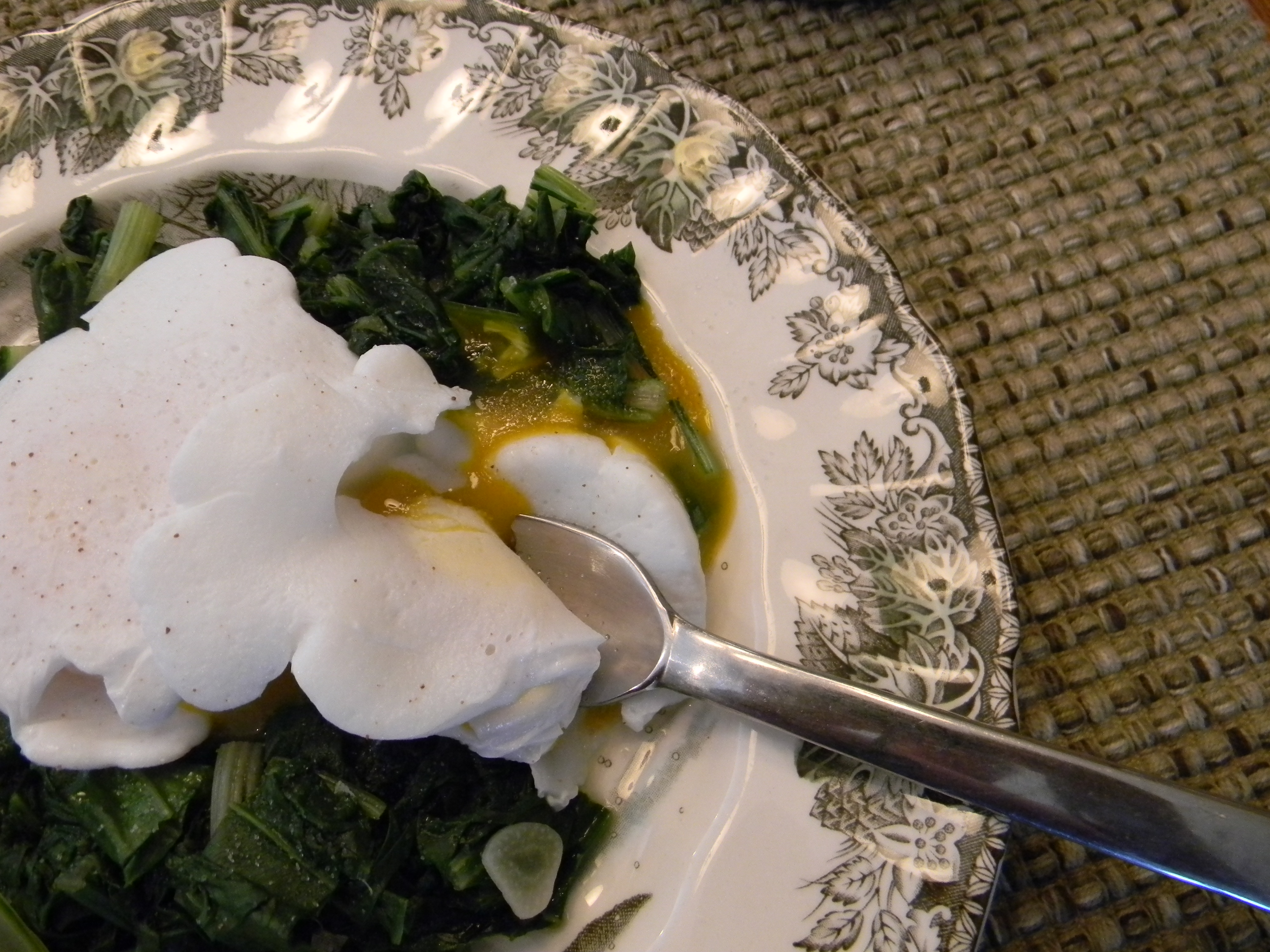
Swiss Chard with Poached Egg

  • 2 bunch of Swiss chard
  • 1 bulb garlic, cloves sliced
  • 1 Tbsp olive oil
  • 4 farm fresh eggs (we love duck eggs)

Chard picked only moments ago

  1. Wash chard well in cold water.  Chop stems coarsely, set aside.  Stack leaves on top of each other.  Cut into 1/2 inch ribbons.
  2. Heat oil in large skillet, with tight-fitting lid, over medium-high heat.  Add stems first, sauteing for 2-3 minutes.  Add leaves and garlic, coating with the oil in pan.
  3. Toss until wilted but still bright green.  Divide on two plates, top with poached eggs.

Poached Eggs

  1. Place approximately 3-4 inches of water in medium skillet with straight sides; add 2 Tbsp of white vinegar to water.  Bring to just boiling then reduce to a simmer before adding the eggs (bubbles should not break the surface).  The barely simmering water encourages the eggs to sit there quietly, without flapping around and losing their shape.
  2. Break each egg into a small cup or ramekin.  Slip eggs carefully, one at a time, into the simmering water.  Let the water come into the cup, then gently slide out.
  3. Simmer for exactly 3 minutes for medium-firm yolks.  Adjust the time up or down for runnier or firmer yolks.  Cook to desired doneness.  Remove each egg from water with slotted spoon and drain this on a tea towel to absorb the excess water.  Place immediately on top of sautéed chard.

Serves 2

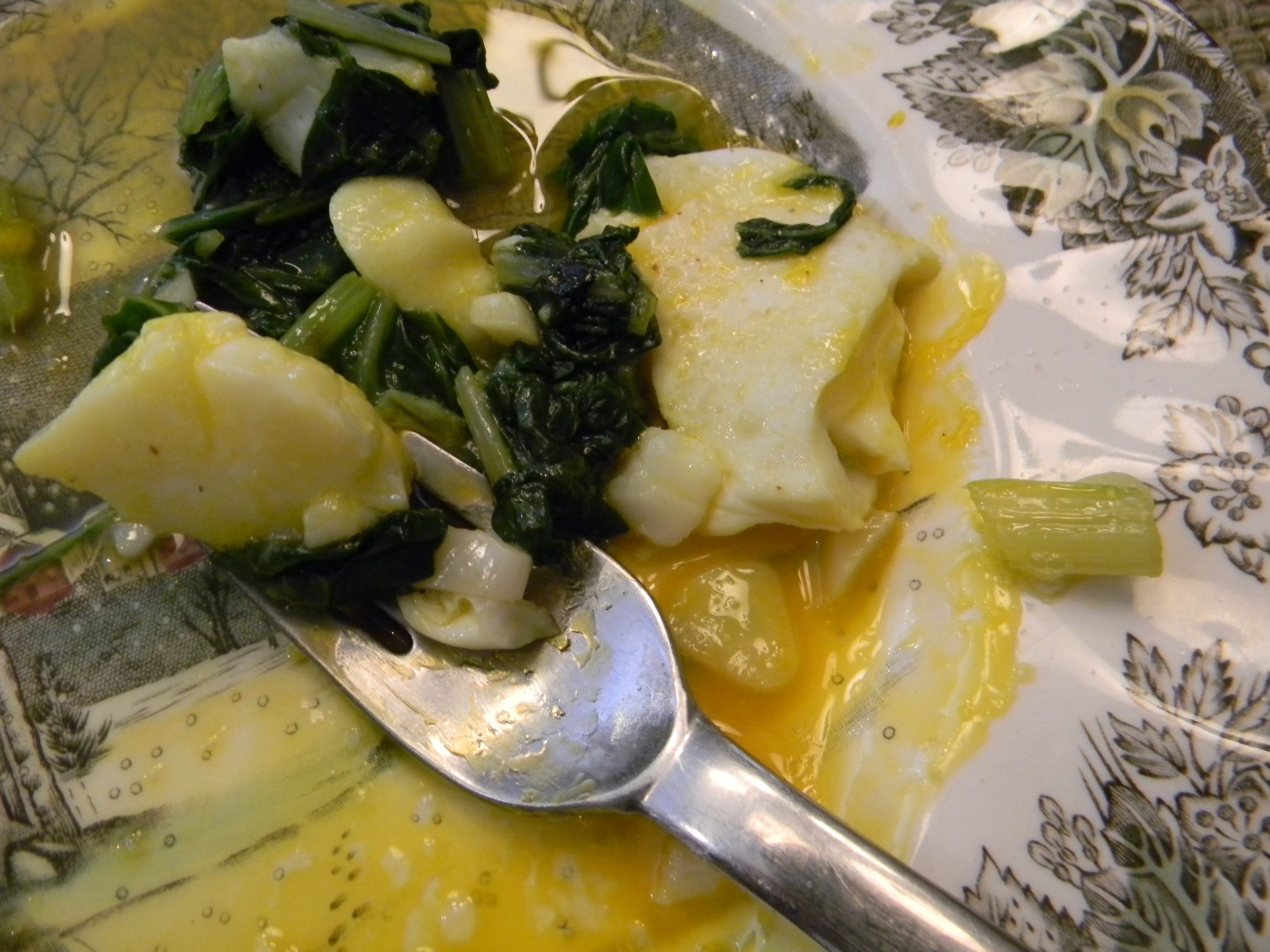
Perfect fuel to start the day

“Yes, I am positive that one of the great curatives of our evils, our maladies, social, moral, and intellectual, would be a return to the soil, a rehabilitation of the work of the fields.”  –Charles Wagner

Deeply satisfied and ready to weed!


Posted in Farm News, Recipes | Tagged , , , , | 5 Comments

Treading Water

There are things about farming one can’t control.  For example, the weather.  In May, when we received 14 inches of rain in one week, we stayed stoic.  We did not panic… we waited to see how the garlic and the land adapted.  We thought we had a chance at a half-way decent crop.  The land dried out; we kept the weeds down.  We knew we had already lost 50%, yet we continued to feel the glass was still half full.

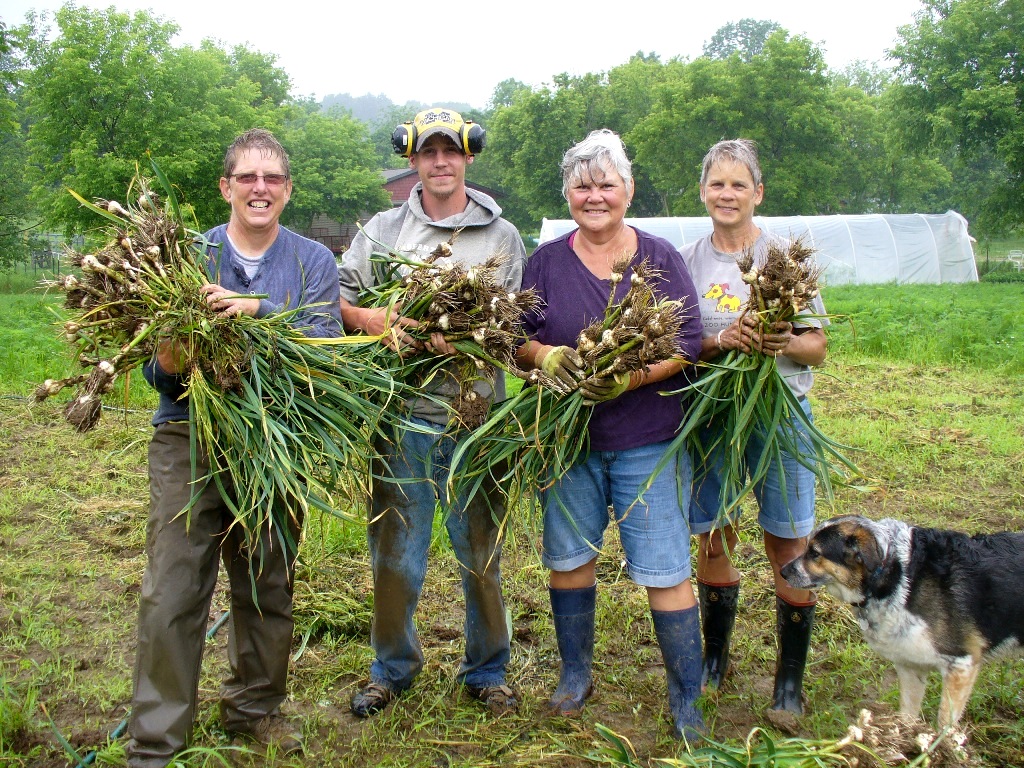
Then a few days after we had harvested the scapes, we received another 4.5 inches of rain.  It was critical, as this is the time that the bulbs are forming their papers.  All week-long it was cool and rainy.  The bulbs were literally absorbing the water like little sponges.  This is when Val and I went out to pull a few bulbs and check their condition.  The field was in two inches of standing water.  We had to make a decision.  Pull the crop now and sacrifice bulb size or leave it in and watch it rot.  We elected to pull the crop, but not without a brief melt-down.  We then put our big-girl pants on and proceeded with the task at hand.

Low yield but high spirits!

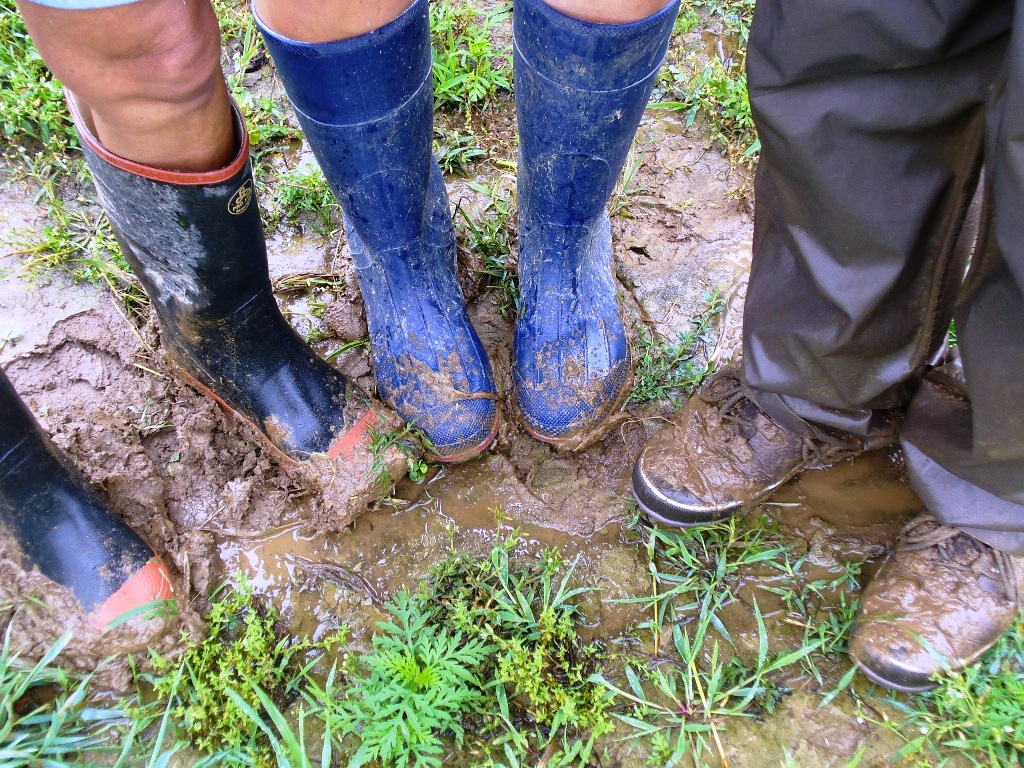
Val, Zac and I started pulling garlic.  Our neighbor Lynne saw that we were harvesting in the pouring rain, grabbed her wellies and came out to help.  What usually takes us about five days to complete took 1.5 hours.  Yet in spite of the circumstances, no one complained, no one grumbled, we simply pulled garlic.

Mucking around!


So for the third consecutive year, we have had a compromised garlic crop.  But when you love something, you do not give up on it.  At one time it was one of our major crops; today it is crop of distinction that has a reduced role.  The stock is expensive and without the needed financial return other crops have stepped up and taken its place in terms of yield and return.  We have learned to diversify in order to succeed; to change in lieu of giving up.  Garlic, the stinking rose is beloved and will always have a place of honor on our land.  We continue to evolve and learn each year.  Maybe, just maybe the garlic gods will hear our plea.  In the meantime we will simply enjoy life and each other!

Val who inspires by being Val!

It was stressful week, yet when we brought our little heads of garlic to market, our customers were supportive and we still managed to sell out.  To all our market customers:  “We love you.”

“We may be soaked, but we haven’t drowned!!”  –a Val…ism

Posted in Uncategorized | Tagged , , | 1 Comment

How the Land Inspires

Brickyard Farms is celebrating tens years of working the land.  Val and I along with Val and Cate before me, have fed many people over the years from these five and one half acres.  We can’t remember a time when someone has visited the farm and not gone home with fresh veggies in season.  Our enthusiasm shows each time we give a tour or explain what we do and how we do it.

This year we are thrilled to have several people who are well-connected to our farm want to grow their own gardens!  As I took pictures of each of them I asked two questions:  Why did you start a garden; and what does your garden mean to you?  Their answers were as varied as the individuals themselves.  I am honored to share a little about each of their journeys with you.
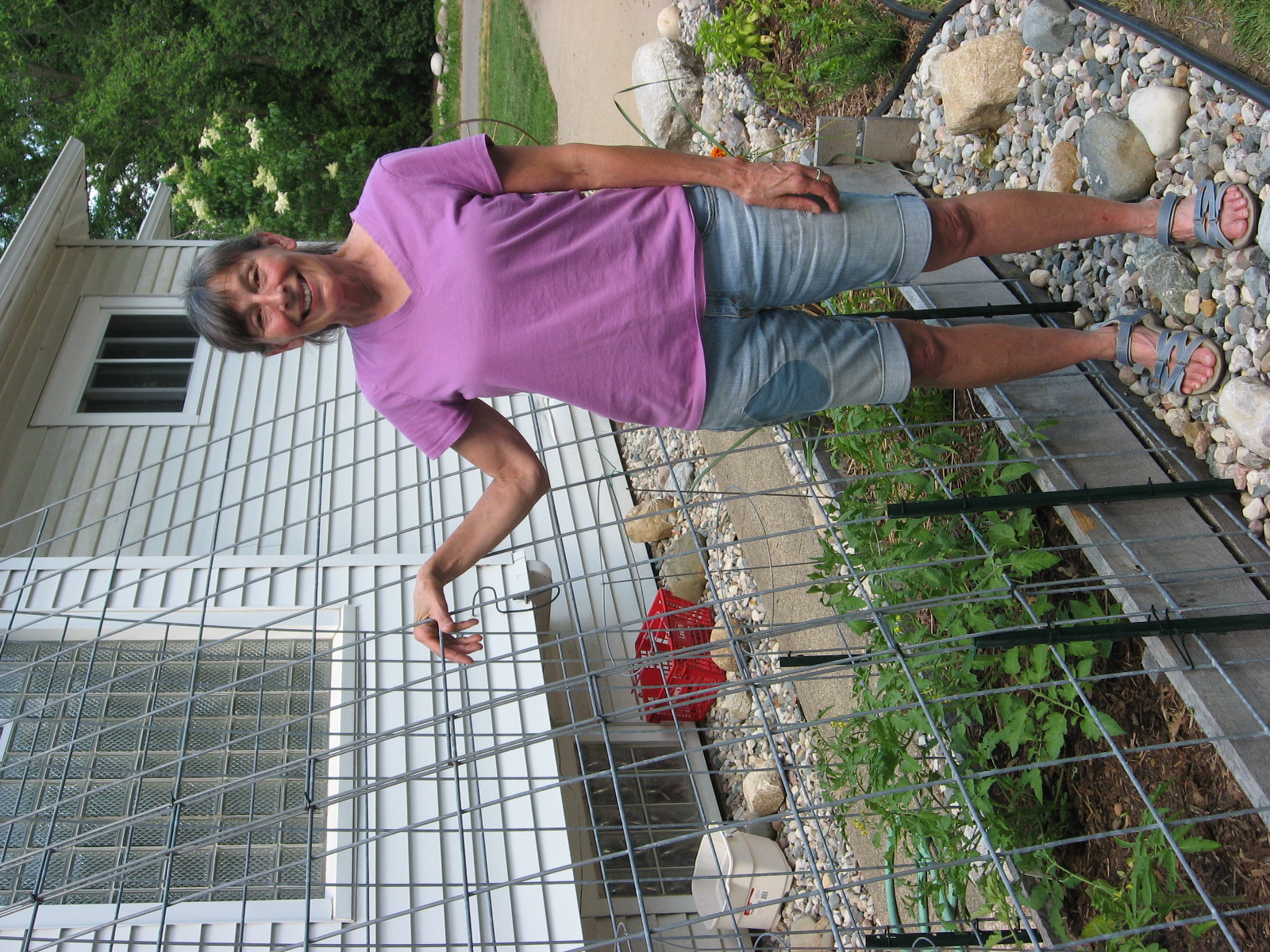
Our neighbor Lynne Serfling or ‘Lynner’ as we so often call her, is our go-to person when we are at market.  She makes sure that things are watered and the dogs let out when we are away.  She loves the farm and helps out on occasion when needed.  When she asked if I would till a piece of land behind her garage this spring I was surprised and asked what she wanted to grow.  She said that she had been giving it some thought through the winter.  She wanted to grow her own sweet corn and winter squash.  When we decided not to grow winter squash because of the glut at the market she said there was no reason we should be without squash!   Lynner’s family had always had a large garden.  It was an important part of their food budget.  Times were hard when she was a child and she remembers planting, weeding and harvesting many kinds of vegetables with her father and siblings.  “We grew a garden out of necessity back then, but working the land gets into your skin.  Plus I can’t let you have all the fun!”  She selected a sweet corn variety called Bodacious, along with Blue Kuri, butternut and acorn squash.  When she came home from work the other night, she called and left an excited and tearful message on our phone.  “I know it’s late, but I had to call and tell you MY CORN IS UP!  It hasn’t even been a week and it’s up!”  Then, while weeding her garden the other day she had an epiphany.  She had realized she had always worked on someone else’s garden or land and had never had her own land to work.  Now, as she stewards her own plot, she gives thanks for the healing quality of this pursuit.
Zac and his potatoes

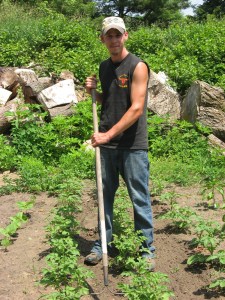
Next we have our farm-hand Zac.  Zac is simply a work-horse!  He plants, weeds and harvests right along side us each day.  You would think he would be absolutely sick of looking at veggies and weeds at the end of the day, but he too wanted to plant a garden, behind the house he rents from us.  For Zac his garden is an effort to take control of his grocery budget and learn how to put up food for winter.  Although Zac has never been an adventurous eater, that doesn’t stop him from planting the things that he does eat like: carrots, peppers, onions and watermelon.  The potatoes are for his mom.  He said, “I particularly like to get up each morning and water my garden.  It’s amazing how many little things you notice; how fast it grows, whether or not there are any pests, that sort of thing.  I  like to share it with Xander (his son) when I have him every other week.  I want him to know there are others things to eat besides hot dogs!”  Zac and I are looking forward to canning salsa together when the tomatoes are on.  “I love your salsa!  I want to make my own!”

Tim and Steph among their herbs

Tim and Stephanie Pierce are new to Cloverdale.  When their internship ended at a previous farm their need to rent a house and our need for new renters coincided perfectly.  They were wanting to try something new that allowed them to earn income and also be flexible enough for Tim to do the wood-working he so loves.  We offered a garden plot, use of a hoop-house and access to a workshop.  With these bases covered, Tim and Steph have started a business called Dirt Song.  “It’s a place to start,” said Tim.  “I’m sure it will evolve into other things.”  Tim has made many beautiful items with wood, each one is unique and one of a kind.  Steph is interested in making value-added items that will use the herbs they grow for an expanded and creative purpose.  “I’m not interested in being self-sufficient.  I would rather be inter-dependent with like-minded people.  We don’t know where all this will lead, but where ever it is we’ll do it together.”

Jelania with her 'cattle fence'.

Jelania Hale lives in Kalamazoo.  A long time friend of Lynner’s, she loves the fresh produce that grows here.  Being a vegetarian she particularly enjoys knowing that we are a no-spray farm that uses organic methods.  She thought why couldn’t she grow a few things herself?  Although she lives in a city neighborhood she has designed a small garden that maximizes her minimal space.  Tucked in between two driveways, she has a narrow raised bed that holds tomatoes, basil and garlic.  She has the option of growing vegetables up her ‘cattle fence’ or using it to support her tomatoes.  She can also attach a shade cloth if needed.  The flower beds around her garage and fenced yard are home to beans, lettuce and other herbs.  “I like knowing how my food is grown.  I can’t tell you how often I come out here to water, check on things or just talk to my plants,” say Jelania.  “I enjoy having things visually appealing, so the rocks and potted marigolds add to the esthetics of the raised bed.  It’s amazing what you can do with a small space.”

Each of our friends feels a sense of stewardship to their garden.  With attention to what each of their gardens need, their efforts will be rewarded with food grown for their own table, by their own hands.  I know each spring when row after row of seeds are sown, there is nothing quite like the thrill of seeing tiny green seedlings breaking ground and reaching for the sun.  It’s a birth and there you stand like a proud parent.

Then it starts.  You read, you experiment, and you will want the best for those seedlings.  They are yours and you are responsible for their success.  How much water is too much; how much too little?  Those little seedlings will inform you whether or not you are on the right track.  You will weed and weed again.  Each day you will observe, didn’t it grow twice as big after the last rain?  You will curse the cut-worm or the slug that caused it to fail.  You will take it personally.  You will uncover your creativity and discover solutions for problems and challenges.  All the while, each of you are invested in the outcome.  With shovels and hoes in hand, your investment will bare fruit as you slowly become closer to the earth.  You will find you do indeed reap what you sow.

“To forget to dig the earth and tend the soil is to forget ourselves.”  –Gandhi

Posted in Essays, Farm News | Tagged , , , | 2 Comments

The “Scapes” Are On!

Scapes growing the the field

The Fulton Street Farmers Market opens the first Saturday in May.  It always amuses me that once we ask our customers how their winter went, the next question they ask is, “When is garlic?”  Now mind you, garlic is two months away, yet it is one of the first things on their minds.  This kind of hard- won enthusiasm is not be taken for granted.  We let them know that scapes are first, followed by the garlic bulbs approximately three weeks later.

You might ask, “What is a garlic scape?”  For the uninitiated, a scape is the flower head, or bulbil of the garlic bulb.  In late spring each bulb sends up a bright green flower head as one way of reproduction.  If left to grow these bulbils will develop small seeds, after the bloom dies back.  Garlic growers cut off these bulbils or scapes for two very good reasons.  One, if left on the plant the bulb will send all its energy to the bulbil and seed development rather thank bulb size; and two the scapes themselves are a delicious culinary treat.  We consider them to be one of the first signs of spring, in the same league as asparagus, new potatoes and peas.  The garlic scape is wonderful in eggs, potato salads and pastas, to mention just a few.  It has a texture similar to asparagus or green onion, yet tastes like garlic.  Milder than the cloves themselves, it is versatile and delicious.  When purchasing scapes make sure they are bright green in color and snap when you break off a small piece near the end of the stalk.  The smell will indicate the strength of the garlic.  There is also a white flower pod near the upper part of each scape.  These are tough, not edible and should be discarded.

Garlic scapes also freeze well.  Cut them on the diagonal in one inch lengths. Next simply blanch them in boiling water for 15 seconds, then plunge them in an ice water bath to stop the cooking process.  Spin them dry in a salad spinner or pat them kindly with a tea towel.  They can now be put in freezer bags or a container for future use.  The culinary uses are virtually limitless.  Use them whenever you want the mild taste of garlic.

Spring Potato Salad

  • 2 lbs small new potatoes, skins on, halved
  • 1/2 cup garlic scapes, chopped
  • 4 Tbsp olive oil, divided
  • 2 Tbsp Dijon mustard
  • 1 Tbsp white wine or sherry vinegar
  • Kosher salt and fresh ground black pepper to taste
  • 1/2 cup pitted and halved kalamata olives
  1. Boil new potatoes in salted water until just done, approximately 10-12 minutes.  Drain and cut in half again as soon as they can be handled.
  2. Saute garlic scapes in 1 Tbsp olive oil for 2 minutes.
  3. Mix the remaining 3 Tbsp olive oil, Dijon mustard, vinegar and salt/pepper for dressing.  Add olives and dressing to warm potatoes.
  4. Toss gently together to combine.

Serves 6

“Good food ends with good talk.”

–Geoffrey Neighor

Posted in Book Excerpts, Farm News, Recipes | Tagged , , , , | 2 Comments